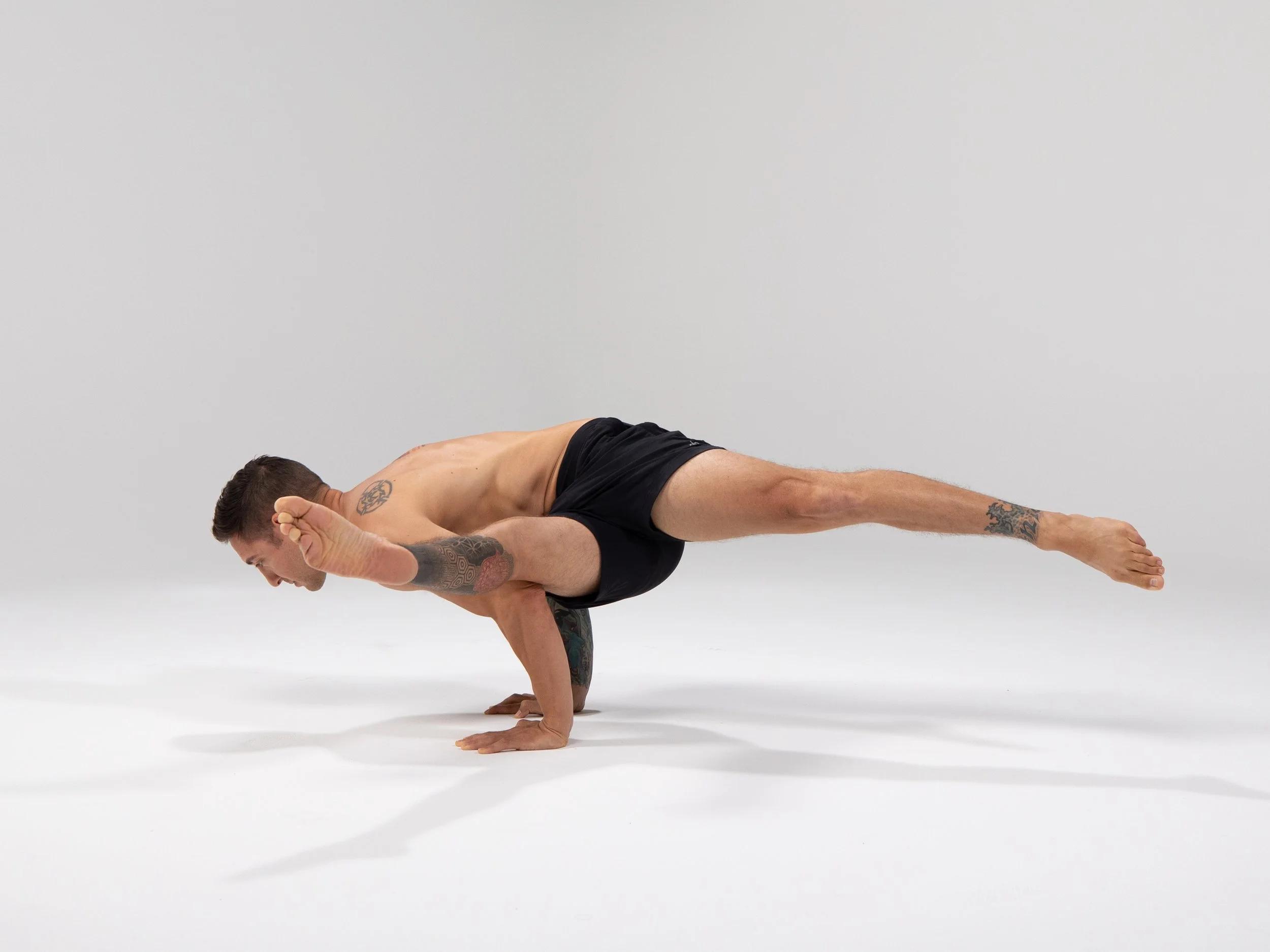
 Eka Pada Koundinyasana is an advanced arm-balancing yoga posture that combines core strength, arm stability, spinal rotation, and leg extension.
Named after the sage Koundinya, this pose challenges practitioners to balance the body while extending the legs in different directions.
There are two commonly practised variations: Eka Pada Koundinyasana I, featuring a twisting balance with the legs extending in opposing directions, and Eka Pada Koundinyasana II, in which one leg extends sideways while the other extends backward.
1. Benefits of Eka Pada Koundinyasana
Builds upper-body strength
Strengthens the shoulders, triceps, wrists, and chest while developing stability through the arms.
Develops core control
Engages the abdominal muscles and obliques to help lift and stabilise the body.
Improves coordination and rotation
Develops body awareness, balance, and controlled spinal rotation.
Challenges hip and leg mobility
Requires a combination of hip flexion, hamstring mobility, and active leg extension.
These benefits depend on correct technique and progressive practice. The pose is not necessary for achieving general fitness or flexibility.
2. Step-by-step instructions
The following instructions describe Eka Pada Koundinyasana II, the side-extending variation.
Step 1 — Begin in a lunge
From Downward-Facing Dog, bring your right foot forward between your hands. Keep your left leg extended behind you.
Step 2 — Position the thigh
Bring your right shoulder beneath your right thigh as comfortably as possible. Place your hands shoulder-width apart on the mat.
Step 3 — Shift your weight forward
Bend your elbows carefully, similar to Chaturanga. Engage your abdomen and press firmly through your palms.
Step 4 — Lift and extend
If stable, lift your back foot and extend the back leg. Gradually straighten the front leg sideways, keeping your chest lifted and shoulders controlled.
Step 5 — Hold and release
Breathe steadily for 1–3 breaths initially. Bend your knees and lower your feet gently. Repeat on the other side.
Important: You do not need to straighten the front leg or fully lift the back foot immediately. Master the preparatory balance first.
3. Breathing technique
- Inhale: Lengthen the spine and prepare the body.
- Exhale: Engage the abdomen and shift your weight forward.
- Continue breathing: Avoid holding your breath while balancing.
- Exit: Lower your feet with control and take a few relaxed breaths.
4. Safety precautions
Eka Pada Koundinyasana is an advanced posture and is not suitable for everyone.
- Avoid practising with wrist, elbow, or shoulder injuries.
- Do not force spinal rotation or leg extension.
- Use a non-slip yoga mat and, if needed, a qualified instructor's guidance.
- If you experience sharp pain, numbness, dizziness, or joint discomfort, exit the pose.
- If you have persistent lower-back pain or spinal problems, get individual guidance from a qualified clinician or yoga therapist before attempting this posture. Eka Pada Koundinyasana is a practice in strength, patience, and precision—not simply a test of flexibility. Build a reliable foundation with core work, arm balances, and twisting postures before attempting the complete expression.