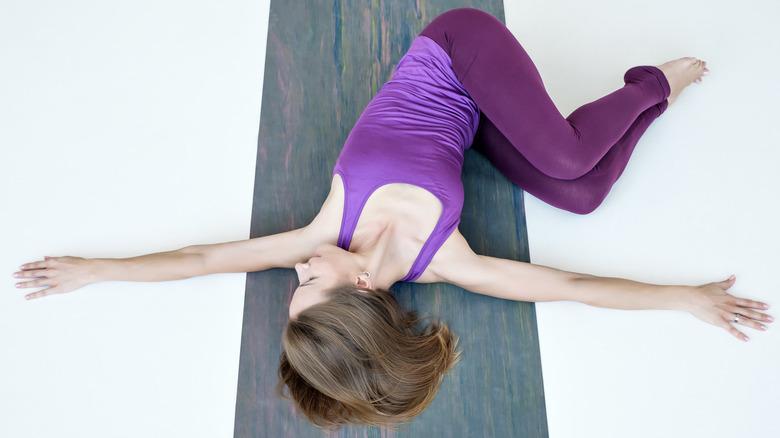
 Jathara Parivartanasana, commonly known as Revolved Abdomen Pose or Supine Spinal Twist, is a reclining yoga posture that involves rotating the legs to one side while lying on the back.
It gently mobilizes the spine, stretches the outer hips, and encourages relaxation.
The Sanskrit name combines Jathara (abdomen), Parivartana (turning or revolving), and Asana (pose).
1. Benefits of Jathara Parivartanasana
Spinal mobility
Encourages gentle rotational movement of the spine and may help ease mild stiffness when performed comfortably.
Hip and lower-back relaxation
Gently stretches the outer hips and muscles around the trunk, depending on the variation.
Stress relief
Slow breathing in this supported posture can encourage relaxation and help settle the mind.
Other potential benefits include:
- Improving body awareness and coordination.
- Providing a gentle stretch for the abdominal and chest regions.
- Serving as a cool-down posture after a yoga session.
- Supporting a relaxing bedtime routine.
Note: Although the pose rotates the abdomen, it does not directly burn belly fat, detoxify organs, or guarantee improved digestion.
2. How to Perform the Pose
Step 1: Lie on your back
Lie comfortably on a yoga mat. Extend your arms sideways at shoulder level, palms facing upward or downward.
Step 2: Bend your knees
Bring both knees toward your chest, keeping your shoulders relaxed and your breathing natural.
Step 3: Rotate gently
Slowly lower both knees toward the right side. Keep the movement comfortable, and allow your left shoulder to remain grounded if possible without forcing it.
Step 4: Hold and breathe
Stay for 3–5 slow breaths, or around 15–30 seconds. Keep your neck relaxed; look upward if turning your head feels uncomfortable.
Step 5: Repeat on the other side
Bring your knees back to the centre with control, pause, and lower them toward the left side.
3. Breathing Technique
- Inhale: Bring your knees toward your chest or return them to the centre.
- Exhale: Allow your knees to move gently toward one side.
- During the hold: Breathe slowly and naturally without holding your breath.
- Return: Engage your abdomen lightly and bring your knees back to the centre with control.
Avoid forcing the twist to make your knees touch the floor.
4. Precautions and Contraindications
Practise gently and seek guidance from a qualified yoga therapist or healthcare professional if you have a relevant medical condition.
- Lower-back pain or disc problems: Use a small range of motion. Avoid the pose if it aggravates symptoms.
- Pregnancy: Avoid deep, uncomfortable twists, particularly later in pregnancy; seek pregnancy-specific guidance.
- Recent abdominal or spinal surgery: Wait for medical clearance.
- Hip or shoulder injury: Modify the position to avoid pain or strain.
- Osteoporosis or spinal instability: Get professional advice before practising spinal rotation.
Stop immediately if you experience sharp pain, numbness, tingling, dizziness, or pain radiating down a leg.
Best time to practise: During a gentle yoga session or as part of a cool-down. Avoid deep twists immediately after a heavy meal.