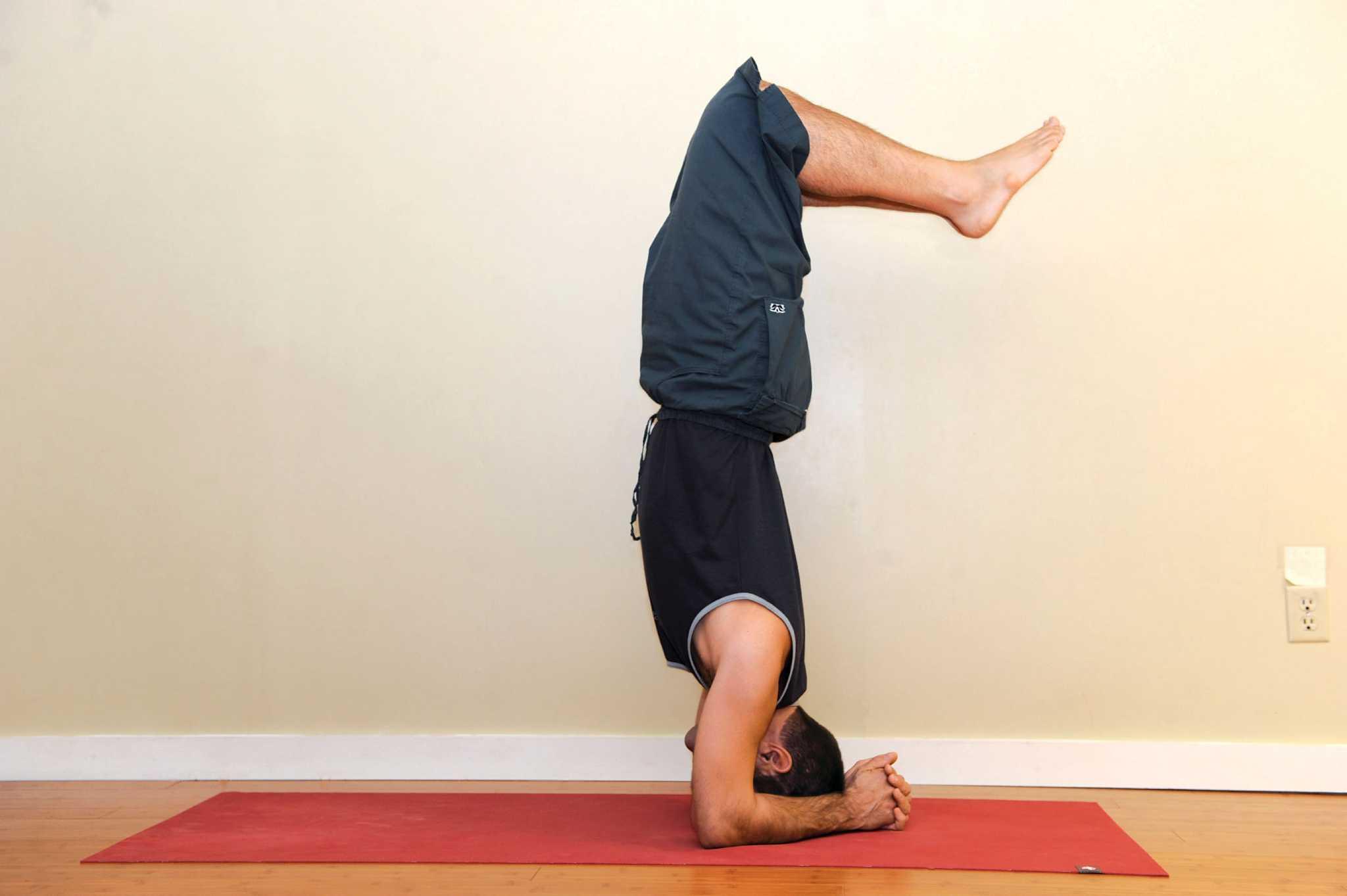
 Salamba Sirsasana (Supported Headstand) is a traditional inversion in which the practitioner balances upside down with the head and forearms supported on the floor.
Often called the “King of Asanas” in modern yoga traditions, it requires progressive training in shoulder stability, core strength, balance, and body awareness.
Its variations range from beginner-friendly preparations to advanced leg positions and twisting movements. The priority is always a stable, pain-free position rather than achieving the full inversion quickly.
1. Main variations of Salamba Sirsasana
1. Salamba Sirsasana I — Classic Supported Headstand
Foundation
The legs extend vertically, with the forearms supporting the head and helping stabilize the body. Maintain an active shoulder girdle and a neutral neck.
Focus: alignment, shoulder stability and core control.
2. Ardha Sirsasana — Half Headstand Preparation
Preparation
Keep the forearms grounded, lift the hips and walk the feet closer while keeping the feet on the floor. This develops the strength and positioning needed before attempting an inversion.
Focus: shoulder endurance and body awareness.
3. Tuck Headstand
Intermediate
From a stable inversion, bend both knees towards the chest rather than extending the legs straight up. This is a controlled balance variation, not a beginner's first inversion.
Focus: abdominal control and balance.
4. Eka Pada Sirsasana — One-Legged Headstand Variation
One leg extends upward while the other bends or lowers under control. Keep the pelvis steady and avoid twisting or arching the lower back.
Focus: unilateral control and pelvic stability.
5. Konasana — Wide-Legged Headstand
From a stable headstand, separate the legs into a controlled straddle. Keep both legs active and the torso vertically aligned.
Focus: hip mobility, adductor control and balance.
6. Baddha Konasana Headstand
Bend the knees outward and bring the soles of the feet together, forming a butterfly-like shape while inverted.
Focus: hip external rotation and trunk stability.
7. Padmasana in Sirsasana — Lotus Headstand
The legs form Lotus while the body remains inverted. This requires substantial hip mobility and an established, stable headstand.
Focus: advanced balance and hip mobility. Never force the knees into Lotus.
8. Scissor or Split-Leg Headstand
One leg reaches forward while the other moves backward, creating a split-leg shape. Keep the pelvis controlled and avoid excessive spinal extension.
Focus: hamstring flexibility, hip control and balance.
These are commonly taught headstand variations, although naming and classification differ between yoga traditions.
2. Benefits and limitations
With appropriate instruction and controlled practice, headstand training can develop:
- Shoulder and upper-body endurance.
- Core strength and postural awareness.
- Balance, coordination and concentration.
- Confidence in controlled inversions.
However, headstand is not necessary to achieve these benefits. Claims that it detoxifies the body, cures hormonal problems or improves brain function are not established medical benefits.
3. Safety precautions
Headstand places substantial demands on the neck and shoulders. It should be learned with a qualified yoga teacher, rather than by kicking up independently against a wall.
- Avoid practice if you have neck or cervical-spine problems, glaucoma or retinal disease, uncontrolled high blood pressure, or certain cardiovascular conditions unless your clinician specifically clears the activity.
- Stop immediately if you feel neck pain, headache, dizziness, visual disturbance, numbness or unusual pressure.
- Do not practise on your own when learning, and never force your body into an advanced variation.
- If you have back stiffness or spinal issues, begin with non-inverted preparations and obtain individual guidance before attempting headstand.
For a gentler alternative, try Legs-Up-the-Wall Pose (Viparita Karani).